Education: The Key to a Broken Social Elevator?
This article was written by Samuel Lado
What level of inequality can a society tolerate? This question, which has no simple answer and is the source of multiple debates today, has been raised throughout history by many intellectuals. Without undervaluing other perspectives on inequality of opportunity, in this article I will adopt the theoretical framework developed by John Rawls, who argues that individuals with the same talent and abilities, as well as the same desire to use them, should have the same chances of success, regardless of their initial position in society. Building on this framework, John E. Roemer conceives inequality of opportunity as the sum of two factors: circumstances and effort. The first refers to those characteristics over which individuals have no control. For example, the economic situation of the household where they are born, immigrant background, gender, and, as we will see below, the educational level of their parents. The second refers to the level of effort that individuals exert, which, as recent contributions in this field of study show, can also be influenced by circumstances. Therefore, it is expected that two individuals exerting an identical level of effort should obtain the same result. These ideas have fueled a branch of economics that attempts to empirically estimate what part of inequality is attributable to the circumstances that individuals inherit and over which they have no control, and what part can be attributed to differences in the levels of effort they exert. Estimates for Spain indicate that more than 40% of the observed inequality is a product of what is inherited.
Building on this framework, John E. Roemer conceives inequality of opportunity as the sum of two factors: circumstances and effort.
Inequality of opportunity is a major economic problem. Not only does it prevent individuals from developing their potential, but it also acts as a brake on mobility and social cohesion. In short, inequality of opportunity constitutes a threat to the welfare state and endangers the desired economic growth. In this context, education becomes a key tool to combat this phenomenon and ensure the success of the social elevator. I believe it is unnecessary to remind readers that education is a fundamental engine for guaranteeing sustained economic growth, as it increases productivity and fosters innovation. But... what if a person's educational level is determined by the educational level of their parents? If this is the case, as I will demonstrate in the following paragraph, we risk falling into a vicious circle, where education, key to reducing inequality of opportunity, is conditioned by this same inequality and ends up perpetuating a regime of social injustice.
Inequality of opportunity is a major economic problem.
The estimates available for Spain indicate that the educational level of parents substantially conditions the income of their children during adulthood. Those born into households with low educational levels have, on average, annual incomes that are 4,518€ lower than those born into households with high educational levels. One way to mitigate the adverse effect of growing up in a household with a low educational level is to access higher education, something that, in recent decades, a significant proportion of the lower strata of society has achieved thanks to measures adopted to guarantee access to higher education. However, this access has not been equal for all social groups, and significant differences still persist both in access opportunities and in educational outcomes.
Those born into households with low educational levels have, on average, annual incomes that are 4,518€ lower than those born into households with high educational levels.
There are many factors that explain inequalities in access and disparities in outcomes. Again, the role of parents' educational level is decisive, closing the vicious circle where the education of parents, over which we have no control, affects the educational level of their children, which in turn influences their economic opportunities in adulthood. Figure 1, which shows the impact of parents' educational level on the education acquired by their children in adulthood, exemplifies this idea. The data come from the module on intergenerational transmission of poverty from the Living Conditions Survey (ECV), prepared by the National Institute of Statistics (INE). As can be seen, there is a marked intergenerational transmission of educational level. More than 46% of those born into households with low educational levels reproduce the educational level of their parents. In contrast, the probability of obtaining a low educational level when born into a household with a high educational level is 40 percentage points lower. Although a slight improvement is observed over time, unfortunately, the reproduction of educational level has a structural character.
More than 46% of those born into households with low educational levels reproduce the educational level of their parents.
The evidence shows that, if we want to guarantee a fairer society, it is necessary to stop the vicious circle whereby the educational level, especially low educational level, is transmitted from generation to generation. In this sense, public policies aimed at expanding access to education and reducing socioeconomic barriers become fundamental. Only in this way can we strengthen the role of education as a mechanism for social mobility and reduce the persistence of inequality between generations.
In this sense, public policies aimed at expanding access to education and reducing socioeconomic barriers become fundamental.
Figure 1: Impact of parents' educational level on the probability of acquiring a low educational level in adulthood, Spain, 2005, 2011, and 2019.
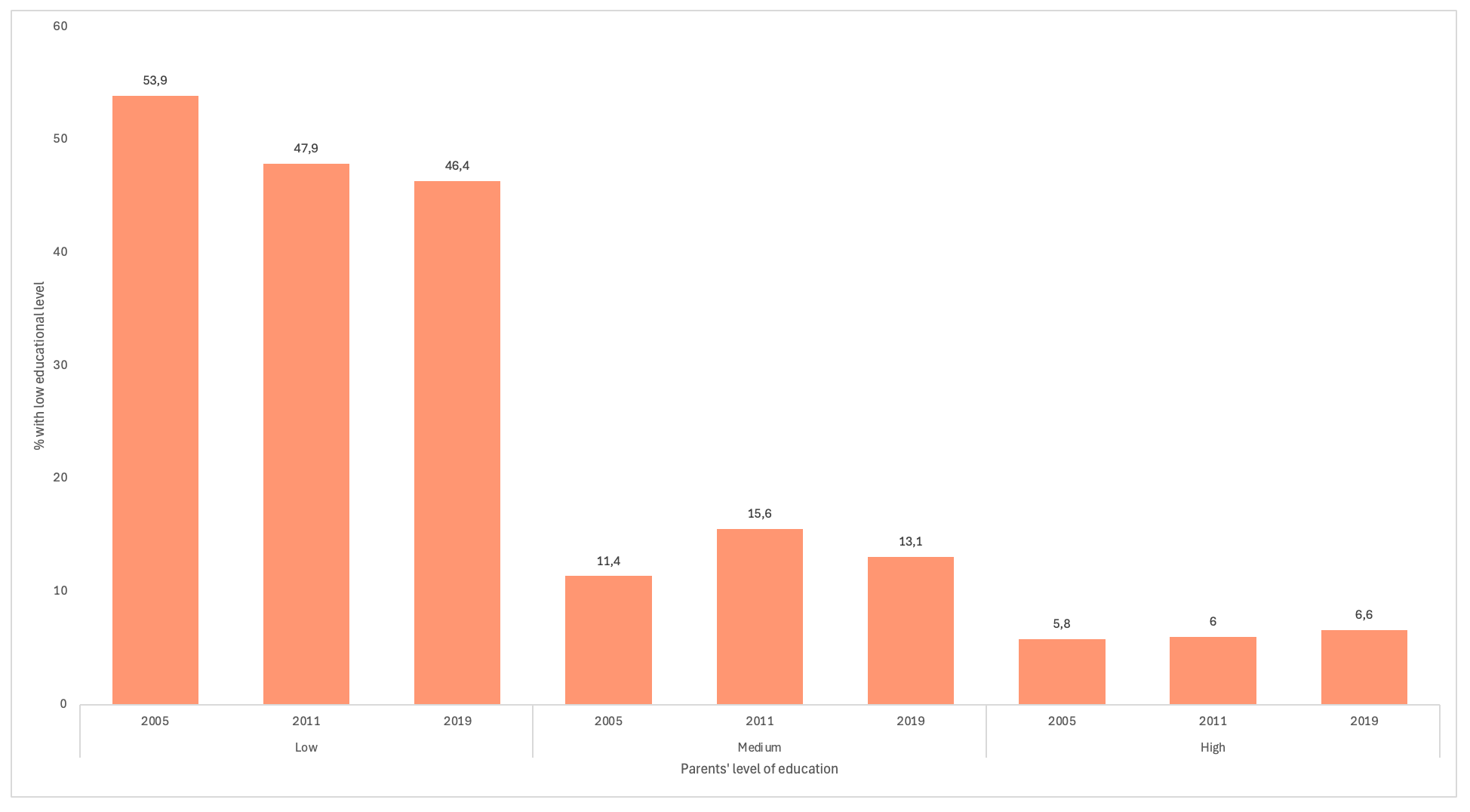
Source: Ayllón, S.; Brugarolas, P.; Lado, S. (2022). The intergenerational transmission of poverty and inequality of opportunity in Spain, Ministry of Social Rights and 2030 Agenda.
Samuel Lado
Samuel Lado is a postdoctoral researcher in Economics at the University of Girona, specializing in inequality, poverty, applied microeconomics, public policy evaluation, labor economics, and public economics.