Can China’s Industrialization Be an Opportunity for Europe?
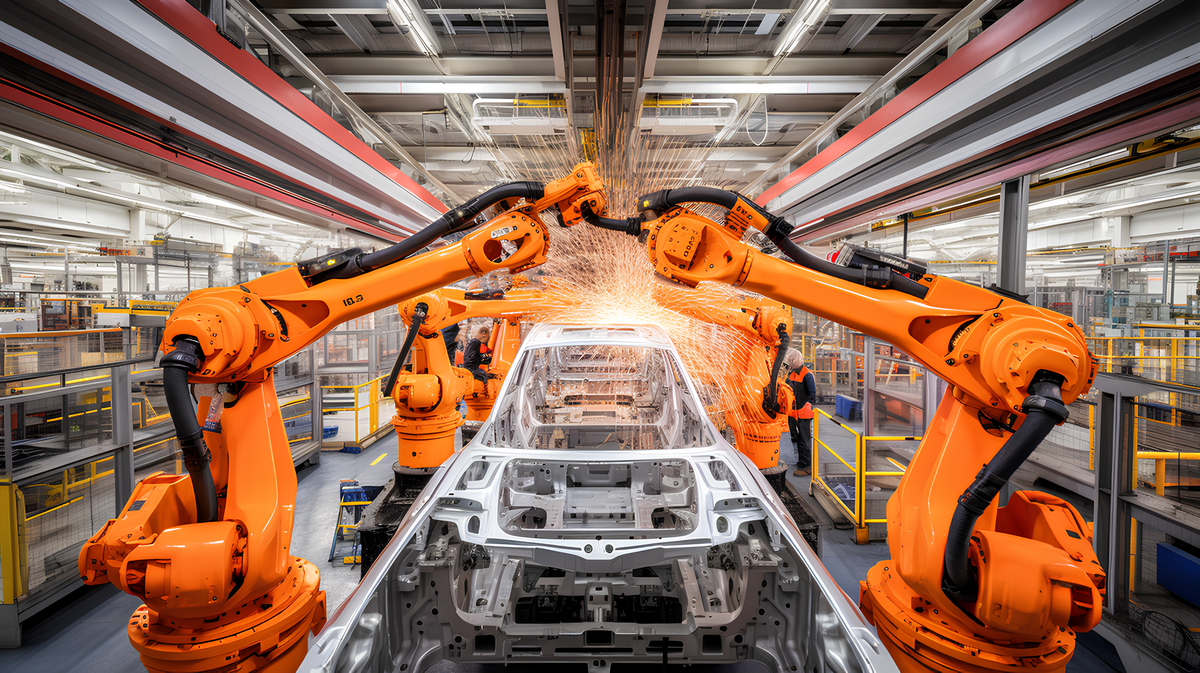
In 2025, China sold more cars to Europe than the Old Continent sold to the Asian superpower (4). This fact reflects a much larger reality: China is becoming the world’s factory.
Why can’t Europe manage to reindustrialize? Why doesn’t the Old Continent have a long-term industrial strategy? What can we learn from the Chinese miracle?
At the end of the 1970s, Deng Xiaoping made a 180-degree turn in China’s economic model. The planned economy gave way to a "socialist market economy" (7). The architect of China’s economic miracle imposed the 50-50 business model (joint venture), where, for example, if a European company wanted to produce in the Asian country, it had to establish a new company in which 50% of the capital would be controlled by the Chinese state and the other 50% by the European company. Over the years, this industrial policy forced European companies to share technology, open new production centers, and train personnel in China (1).
Another key factor behind China’s current industrial power was its accession to the World Trade Organization (WTO) in 2001, after fifteen years of negotiations with the United States and the European Union (1). This milestone consolidated the opening of the Chinese market to Western countries. Globalization, in theory, was supposed to benefit everyone.
Today, Chinese companies not only produce at ultra-competitive costs ("Made in China" model) but also innovate, and in some sectors, they lead global technology ("Invented in China" model).
After several decades, this industrial strategy—along with other factors—has allowed China to evolve from the "Made in China" model to the "Invented in China" model (1). Initially, the Asian country developed reverse engineering (a method involving disassembling products to understand how they were made) to copy Western goods at a lower cost (the "Made in China" model) (1). For years, it was believed that the Asian superpower would not move beyond this pattern. Today, Chinese companies not only produce at ultra-competitive costs ("Made in China" model) but also innovate, and in some sectors, they lead global technology ("Invented in China" model).
In which productive sectors does China have a technological advantage over other industrialized economies?
In vehicle production, in 2025, China had 229 manufacturing companies, employing 1.21 million workers and producing a total of 34.5 million cars (2). In the electric vehicle (EV) sector, the flagship company is BYD. Its production strategy is based on vertical integration (controlling the entire production chain): it manufactures 80% of its electronic components (including chips) and its own batteries. The Chinese automotive giant has also acquired mining rights in foreign countries to secure access to strategic materials for vehicle production (2).
In electric battery production, China holds 70% of the global market. 42% of all batteries produced worldwide are made by a single company: CATL. Since 2017, this multinational has been the world’s leading battery producer (2). CATL is not only the global leader in battery production but also in research and development. At the latest auto show in Beijing on April 24, 2026, the company unveiled a battery with a range of 1,500 kilometers and a charging capability that allows it to go from 10% to 98% charge in just six minutes and thirty seconds (3). No other company in the world matches CATL’s level of innovation in battery technology.
In high-speed rail production, in 2008 (the year of the Beijing Olympics), China had a 120-kilometer high-speed rail network. By January 4, 2026, this figure had grown to 50,400 kilometers of high-speed rail tracks (70% of the global total). By 2030, this number is expected to reach 60,000 kilometers (2). Every day, 10,000 high-speed trains in China transport 16 million passengers (2). Initially, these trains were produced by Western companies (such as Siemens or Alstom). Today, Chinese companies produce these trains with a technological advantage over their Western competitors.
A November 2025 study by the International Energy Agency found that the production costs of electric cars in China are 30% lower than in other industrialized countries
Another significant figure: a November 2025 study by the International Energy Agency found that the production costs of electric cars in China are 30% lower than in other industrialized countries (2). How is such productivity achieved? Among other factors, through the robotization of the production system: in 2025, China used 567 machines per 10,000 industrial workers, a higher figure than Germany (449) and France (195). Additionally, in early 2026, the Chinese government announced that the country had 30,000 fully automated production centers (2). Another key factor is the use of AI in industrial production: according to the Chinese government, in 2025, 30% of industrial companies had implemented AI to plan and adjust production in real time (2).
Academic Richard Baldwin of the IMD Business School in Lausanne, in a 2024 article, stated: "China is an industrial superpower. Its production exceeds the combined industrial output of the next nine largest industrial nations in the world" (3). What has been China’s industrial progression? In 2004, the Asian giant accounted for 9% of global production; today, that figure has risen to 30% (3). Currently, 70% of smartphones, 70% of electric vehicle batteries, 70% of electric cars, and 80% of solar panels are produced in China (3). What is the result of this industrial hegemony? In 2025, China’s trade surplus exceeded one trillion euros (1,014 billion euros / 1,200 billion dollars) (3), representing a 19.8% increase from 2024 (5). To put this surplus into perspective, Spain’s annual GDP is just over one trillion euros.
Consequences and Europe’s Response
What is the European Union’s response to this industrial outsourcing? On March 4, 2026, the European Commission presented the Industrial Accelerator Act, aiming to reindustrialize EU member states. The goal is to increase industrial production from the current 14% of GDP to 20% by 2035, by prioritizing European-made products in public markets and developing member state subsidies for purchasing these products (4).
Europe’s response should come from the Franco-German axis. German Chancellor Friedrich Merz is caught between a rock and a hard place: industrial companies around the Rhine want to protect the German (and European) market, while major groups (Volkswagen, Bosch, and BASF) want to maintain current trade and industrial relations with China, as they have offshored a significant portion of their production at lower costs (4).
A high-ranking European Commission official added that the current trade system between the EU and China must change, but "everything depends on Germany", as it is the only European industrial engine capable of leading this transformation (4).
Paris and Berlin are the cornerstone of the solution to this commercial and industrial imbalance.
Paris and Berlin are the cornerstone of the solution to this commercial and industrial imbalance. For the EU to move forward, it is vital that the two European engines revive the Franco-German axis to lead the change (4).
(1) En trente ans, l’eldorado chinois s’est transformé en piège pour l’industrie européenne
(3) Voyage dans l’usine du monde, où rien n’arrête le rouleau compresseur industriel chinois
(4) Pourquoi l’Europe est incapable de défendre son industrie face au « second choc chinois »